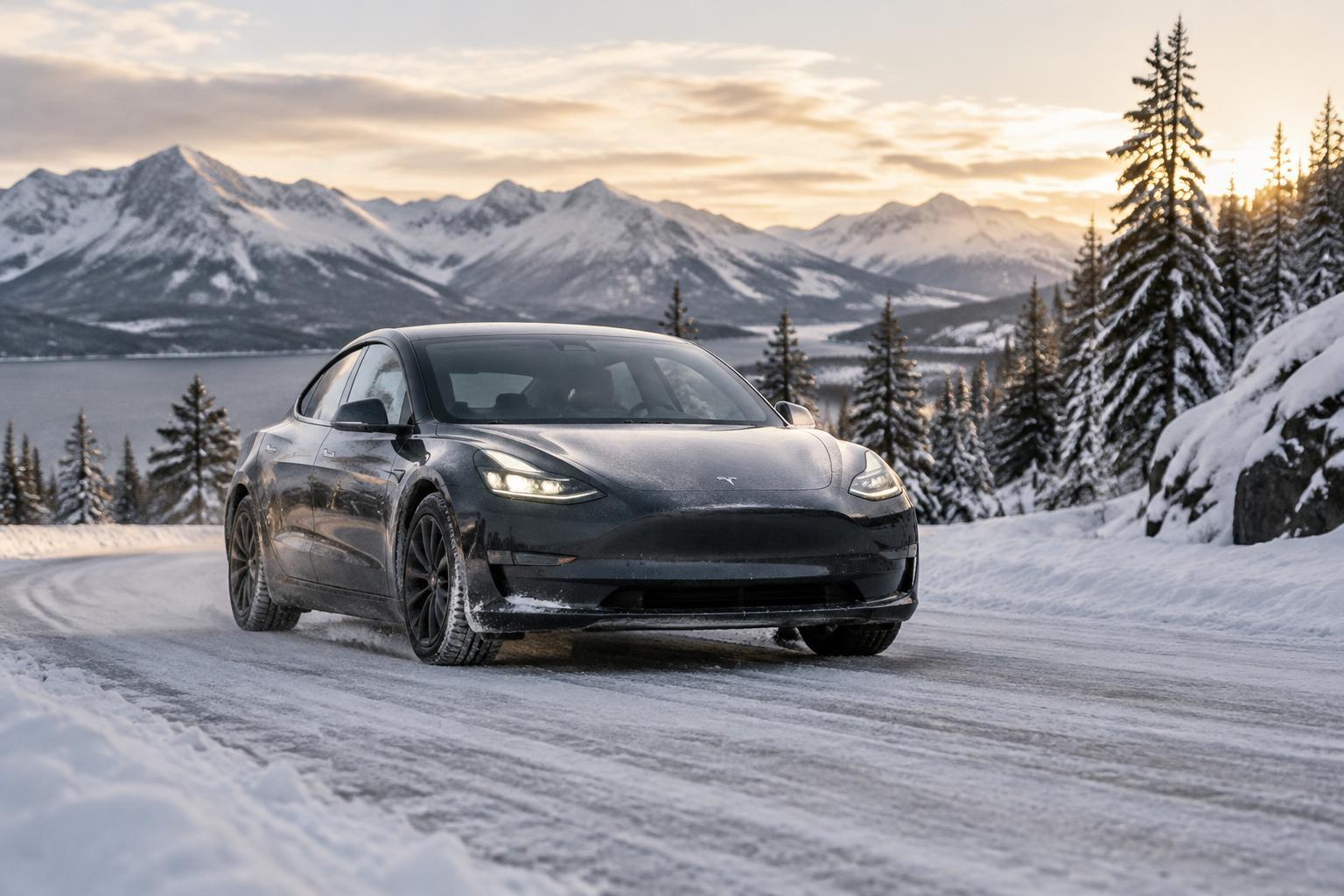
1. Understand Why Tesla Range Changes in Winter
A Tesla typically uses more energy in cold weather because it must warm the cabin and, when necessary, the battery. A cold battery can also have reduced power availability and accept less regenerative braking or charging power. Meanwhile, denser air, standing water, snow and lower tyre pressures can increase the energy needed to move the car.
There is no reliable single percentage for winter range loss. Temperature, speed, wind, journey length, wheel and tyre choice, and your vehicle’s heating system all matter. Repeated short trips can be particularly demanding because the car may need to warm up again each time. Some Tesla vehicles have heat pumps, but heating hardware varies by model and production year.
Use the navigation system’s predicted arrival charge rather than relying only on the range figure beside the battery icon. That displayed distance is based on rated consumption, not a personalised forecast of the road ahead. Where available, the Energy app helps explain consumption and deviations from the trip prediction. Leave a larger arrival buffer when conditions are uncertain, particularly if charging alternatives are limited.
2. Precondition Before Leaving, Preferably While Plugged In
Preconditioning means preparing the cabin and battery before you drive. Turning on climate control through the Tesla app warms the interior and can also warm the battery as needed. For a regular commute, use your vehicle’s scheduling features to prepare the car for your departure time; menu names and available settings can vary with the vehicle and software version.
Whenever practical, keep the car connected to a suitable power supply during preparation. This allows it to draw energy from the connection rather than relying entirely on stored battery energy. A low-power connection may not cover the full heating demand, so being plugged in does not guarantee that the battery percentage will remain unchanged.
Allow more preparation time in severe cold rather than treating a fixed number of minutes as a rule. Use the app’s defrost function when necessary, and physically clear snow and ice from the windows, mirrors, lights and roof before driving. Check that wipers are free before operating them, and never use hot water to release frozen glass or handles. Follow your model’s manual for frozen door-handle procedures.
3. Plan Charging Around a Warm Battery
A cold battery may charge more slowly because the vehicle limits incoming power to protect it. When travelling to a Supercharger, select the actual charging location in Tesla navigation rather than simply driving towards its address. The car can then precondition the battery for charging when appropriate. Some supported third-party rapid chargers may also trigger this preparation, but do not assume that every charger will.
Give the car as much notice as practical by entering your charging destination early. A short drive to a nearby rapid charger may not provide enough time to warm a deeply cold battery. Even after preconditioning, charging speed depends on factors including battery temperature, state of charge, charger capability and site conditions; the advertised peak is not a guaranteed session speed.
For home charging, follow the recommended charge limit shown for your particular vehicle rather than applying one universal percentage to every Tesla battery. Scheduling charging to finish near departure can be useful, especially when combined with scheduled preconditioning. Browse charging accessories for equipment suited to your setup, checking connector compatibility, electrical ratings and outdoor suitability before buying.
4. Treat Tyres, Grip and Regenerative Braking as Priorities
All-wheel drive can help a car move off on slippery surfaces, but it does not remove the limits of tyre grip when braking or cornering. Tyre condition and suitability for the weather matter more than drivetrain confidence. Winter tyres are designed for cold conditions, while suitably rated all-season tyres may be a practical option for milder winters. Choose an approved size and appropriate load and speed ratings for your specific Tesla.
Check pressures when the tyres are cold against the specification on the vehicle’s tyre information label, not the maximum pressure printed on the sidewall. Falling temperatures can lower tyre pressures, and the pressure monitoring system is not a substitute for routine checks. Inspect tread and sidewalls before a long trip, and have persistent pressure loss investigated.
Regenerative braking may be reduced when the battery is cold or at a high state of charge, so deceleration can feel different from one journey to the next. Some vehicles offer a setting that applies the brakes when regeneration is limited; check your manual rather than assuming it is present or enabled. Drive smoothly, increase following distances and be ready to use the brake pedal. Where chains are required, choose snow chains only after confirming the permitted type, wheel size and fitting axle in your Tesla owner’s manual.
5. Protect the Cabin from Water, Mud and Road Salt
Well-fitting all-weather floor mats are among the most useful winter accessories. Look for raised edges to contain melted snow, a surface that is straightforward to clean and a shape matched to the vehicle’s footwells. Driver-side fit is especially important: a mat must stay secure and never interfere with the pedals. Do not stack a new mat on top of an existing one.
Our floor mats collection is a sensible starting point, but check the product’s model and production-year compatibility before ordering. A Model 3 mat is not interchangeable with a Model Y mat, and interior revisions can affect fit even within the same model name. Remove collected water regularly so it does not spill onto the carpet when the mat is lifted.
A boot liner adds protection for wet boots, muddy equipment and winter dog walks. Combine it with boot and frunk storage to keep damp items separate from charging equipment and clean luggage. Secure heavier items rather than leaving them loose, and remove wet clothing promptly: persistent cabin moisture makes misting harder to manage.
6. Carry a Small, Useful Winter Kit
Start with a non-abrasive snow brush, an ice scraper suitable for automotive glass, gloves and a compact torch. Add warm clothing or a blanket for unexpected delays. Carry screenwash rated for the temperatures you expect, and maintain the correct mixture according to the product instructions. Clear cameras and lights carefully, as road spray and salt can quickly reduce visibility.
Keep a suitable charging cable accessible if your journey may involve untethered AC charging. Avoid burying it under luggage, and store it so that wet or dirty sections do not contaminate the cabin. Inspect charging connectors for snow or ice before use, and never force a frozen connector or improvise a heating method. Consult the vehicle manual for charge-port defrosting and release instructions.
Choose additional winter travel essentials around your actual routes rather than filling the car with equipment you will never use. For remote or mountainous journeys, suitable traction equipment and extra warm layers deserve more attention. Accessories should support good preparation, not encourage driving into conditions beyond the capability of the tyres, vehicle or driver.
7. Build a Simple Routine for Every Winter Journey
Before departure, check the weather, route and expected arrival charge. Precondition while connected when possible, confirm tyre pressures regularly and clear the entire vehicle of snow that could slide onto the windscreen or blow onto other road users. Make sure cameras are unobstructed, but remember that driver-assistance features can be restricted by poor visibility and slippery conditions.
On the road, use a comfortable cabin temperature and heated seats or steering wheel where fitted. Localised heating can help you stay comfortable without setting the whole cabin excessively warm, but never compromise demisting to save energy. On longer journeys, moderate speed where safe and appropriate: sustained high-speed driving increases aerodynamic demand, while strong headwinds can further reduce your range margin.
Review the arrival prediction as conditions change and charge earlier if the buffer becomes uncomfortable. Once home, remove wet items, clean road salt from affected surfaces when practical and reconnect the car if that suits your charging arrangement. For a precise fit when choosing accessories, start with the relevant Tesla Model 3 accessories or Tesla Model Y accessories collection, then verify every product against your vehicle’s year and configuration.
Frequently asked questions
How much range does a Tesla lose in winter?
There is no fixed figure that applies to every Tesla or journey. Battery temperature, cabin heating, speed, weather and trip length all affect consumption. Short trips with repeated warm-ups can be particularly inefficient. Use the navigation arrival-charge estimate, watch how it changes and leave more reserve than you would in mild, predictable conditions.
How long should I precondition my Tesla before driving?
The time needed depends on the outside temperature, how cold the battery is and whether the car is connected to power. Scheduled preconditioning is useful for regular departures because the car manages preparation around your chosen time. In severe cold, allow extra time and check that the windows are clear before leaving.
Does a Tesla need to be plugged in to precondition?
No. A Tesla can precondition using energy from its battery, provided sufficient charge is available. Plugging in is preferable when practical because the power supply can support the heating demand and preserve more stored energy for driving. Low-power charging connections may not supply enough electricity to cover all heating needs.
Why is Tesla Supercharging slower in cold weather?
A cold battery cannot always accept high charging power, so the vehicle limits the rate while managing battery temperature. Navigate to the Supercharger through the car’s navigation system to enable charging preparation when appropriate. Arriving with a warm battery helps, although state of charge and charger conditions still influence speed.
Do I need winter tyres on an all-wheel-drive Tesla?
All-wheel drive is not a replacement for tyres suited to the conditions. If you regularly encounter snow, ice or sustained cold weather, winter tyres are worth considering. Suitable all-season tyres may suit milder conditions. Check local requirements, choose the correct ratings and remember that braking and cornering depend on available tyre grip.