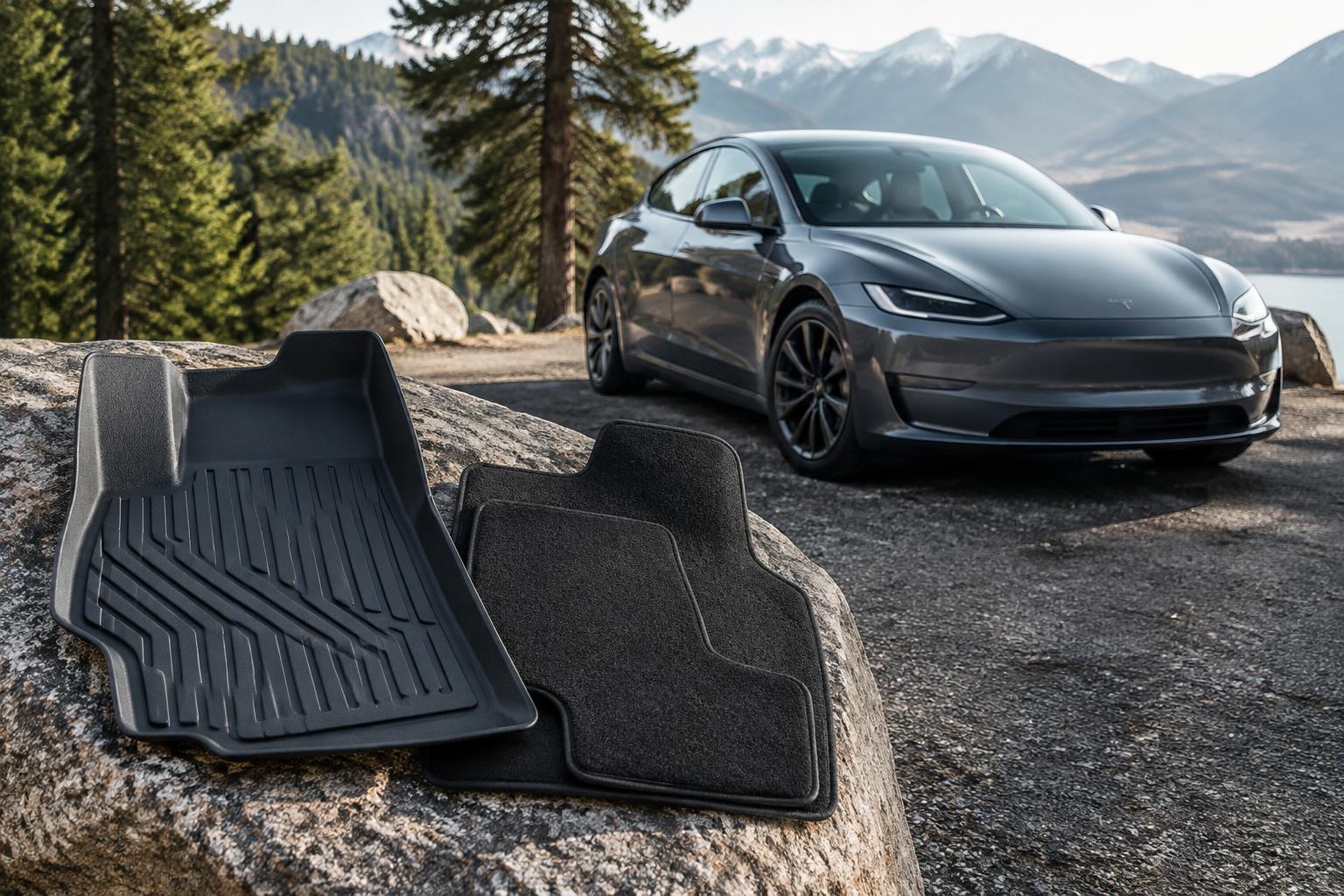
1. Start with your Tesla's exact model and interior layout
Before comparing materials, confirm compatibility with your exact vehicle. Tesla Model 3, Model Y, Model S and Model X have different floor shapes, and a mat designed for one should not be assumed to fit another. Production updates can also change interior details within the same model line. A listing that simply says 'fits Tesla' is not enough; look for the model, supported production years and any exclusions.
Steering position matters, particularly around the driver's footwell. For a right-hand-drive Tesla, choose a set explicitly listed as right-hand-drive compatible rather than relying on photographs. The mat must follow the floor without obstructing either pedal, bunching against trim or sliding into the pedal area. Never stack a new mat on top of an existing one, even if the combined fit initially appears tidy.
Seating layout is another important check. Model Y and Model X have been offered with different seating configurations, depending on year and market, so rear-floor coverage is not automatically interchangeable. Start with the relevant Tesla Model 3 accessories, Tesla Model Y accessories, Tesla Model S accessories or Tesla Model X accessories category, then verify the individual product's fitment information before ordering.
2. All-weather Tesla floor mats: best for wet and messy use
All-weather mats are designed to make moisture and dirt easier to contain and remove. Depending on the product, they may use rubber, thermoplastic elastomer, often called TPE, or a layered construction with a water-resistant upper surface. These materials are not identical, so assess the actual specification rather than treating 'all-weather' as a guarantee of a particular feel, thickness or level of protection.
For frequent rain, muddy walks and family use, shape often matters as much as material. Raised edges can help contain water and loose debris, while moulded channels may keep some moisture away from the soles of your shoes. Higher side coverage can also protect carpet beside the main foot area. However, no removable liner should be treated as a completely sealed barrier: spills can still escape around openings or over the edges.
The main compromise is appearance and feel. Some all-weather mats look distinctly utilitarian, and a deep tread pattern can hold fine grit that needs brushing out. Others have a more restrained surface that suits Tesla's uncluttered interior. If your priority is quick cleaning after school runs, outdoor activities or winter journeys, a well-fitted all-weather set is usually the more practical choice.
3. Carpet Tesla floor mats: best for a softer cabin finish
Carpet mats offer a softer, more upholstered appearance underfoot. They can work particularly well in a Tesla used mainly for commuting, business travel or leisure driving with relatively clean footwear. A neatly bound edge, consistent pile and close fit tend to matter more visually than decorative details. For a restrained cabin finish, choose a colour that complements the existing floor and seat trim.
Quality depends on more than how thick the carpet looks in a photograph. Check the pile, backing, edge construction and any reinforced heel area. The driver's heel repeatedly loads the same small patch during normal pedal use, so that area deserves attention. A suitable non-slip backing or correctly matched retention system is also important; softness should never come at the expense of stability.
Carpet is less convenient when it regularly receives water, mud or sticky spills. Moisture and fine dirt can enter the fibres, making cleaning and drying more involved than with a wipe-clean surface. A waterproof backing, where specified, may help protect the floor beneath, but it does not stop the pile becoming wet. Choose carpet because it suits your routine, not because it appears maintenance-free.
4. Compare coverage, grip and everyday comfort
When browsing Tesla floor mats, compare the outline and coverage before focusing on styling. Look at how closely the mat follows the transmission-tunnel-free floor layout, seat bases and footwell sides. Tesla's electric platform does not mean every passenger floor is identical or completely unobstructed, so a generic flat mat is no substitute for a model-specific shape.
In the driver's footwell, the mat should lie securely and leave clear space for full pedal movement. Use any retention features exactly as instructed, and do not modify a mat to make an incorrect fit appear acceptable. If a newly unpacked liner has curled edges, follow the manufacturer's settling instructions and do not drive with it in place until it sits correctly. After fitting, check pedal clearance while the car is stationary and safely parked.
Consider how the surface behaves under your usual footwear. Deep grooves may be useful for grit, but a very pronounced texture can feel less comfortable beneath thin soles. Check whether the rear set is supplied as separate mats or a wider liner, and which parts of the floor it covers. Product photographs should show these details clearly; if not, seek confirmation rather than guessing from a model name.
5. Match the material to your driving routine
For a daily driver exposed to wet pavements, muddy car parks or children's activities, all-weather mats are generally the easier option to live with. They are also useful when passengers regularly bring sand, food crumbs or garden debris into the cabin. Think about your busiest or messiest normal week rather than the occasional journey when the car stays immaculate.
For mostly dry, low-mess use, carpet can provide the finish you prefer without creating an unreasonable cleaning burden. It is a sensible choice if you vacuum regularly, can deal with spills promptly and have somewhere suitable to dry a cleaned mat. Neither material is universally more premium: precise fit, good construction and suitability for the owner matter more than the label.
A seasonal approach can also work. Some owners prefer carpet during drier months and all-weather protection when conditions become wetter. If you switch sets, clean and thoroughly dry the outgoing mats before storing them flat where possible. Always remove the previous set completely, then repeat the fit and pedal-clearance checks rather than assuming a familiar mat has settled into place correctly.
6. Check what the set includes beyond the footwells
A 'full set' does not have one universal meaning. It may describe front and rear passenger mats only, or it may include selected luggage-area liners. Read the itemised contents carefully, especially if your Tesla has a third row. A boot liner, lower storage-well liner and front boot liner are separate pieces, and compatibility should be checked individually.
Boot protection is often worthwhile if you carry a pushchair, walking boots, sports equipment or a dog. Passenger mats cannot protect the load area from wet wheels or muddy bags. Explore boot and frunk storage accessories alongside footwell mats, checking that a liner allows useful access to underfloor compartments and does not interfere with seat movement or folding.
Avoid buying coverage you will rarely use simply because it is bundled together. A carefully chosen passenger set and one suitable boot liner may serve you better than a larger package with poorly matched pieces. For a broader approach, interior protection accessories can help address specific wear points, but each addition should solve a real problem without compromising access, comfort or safe operation.
7. Choose mats you can clean properly
For all-weather mats, remove loose dirt first, then clean using the method recommended for that material. Many removable rubber or TPE products can be rinsed and washed with a mild cleaning solution, but layered designs may require different treatment. Avoid oily dressings or products that leave a slippery finish. Allow the mats to dry before refitting, and check that the vehicle's underlying carpet is dry too.
Carpet mats benefit from regular vacuuming before grit becomes embedded in the pile. Treat marks with a suitable textile cleaner, test it on an inconspicuous area and avoid soaking the backing unnecessarily. Dry the mats fully outside the vehicle before reinstalling them. Persistent dampness or odour deserves investigation rather than simply covering the area with another liner.
The most useful buying checklist is straightforward: exact vehicle compatibility, correct steering position, secure fit, adequate coverage and a realistic cleaning routine. Use care and maintenance accessories appropriate to the chosen material, and inspect the mats periodically for curling, movement or wear. Choose all-weather for easier management of wet and dirty journeys; choose carpet for a softer finish when your routine allows it.
Frequently asked questions
Are all-weather mats better than carpet mats for a Tesla?
All-weather mats are usually better for frequent rain, mud, sand and family mess because their surfaces are generally easier to clean. Carpet mats offer a softer finish and suit mostly dry, low-mess driving. Neither is automatically better overall: correct fit, secure positioning and the way you use your Tesla should decide the choice.
Do Tesla vehicles come with floor mats?
Included floor mats can vary by model, trim, market and delivery date. Do not assume that every Tesla comes with carpet mats or all-weather liners. Check your specific order details or inspect the vehicle before purchasing, then confirm whether you need a complete set or only additional protection for particular areas.
Will the same floor mats fit a Tesla Model 3 and Model Y?
Do not assume they will. Model 3 and Model Y have different cabin and floor dimensions, and production updates can affect compatibility within each model. Buy mats explicitly listed for your vehicle's model, production version and steering position. For rear mats, check seating-layout compatibility wherever the product listing distinguishes between configurations.
Can I put all-weather Tesla floor mats over carpet mats?
No. Remove the existing removable mats before fitting another set. Stacking can prevent secure seating, increase movement and create dangerous interference around the pedals. Fit the replacement according to its instructions, engage any appropriate retention features and check that the driver's mat remains clear of both pedals throughout their movement.
What is the best way to clean Tesla floor mats?
Follow the mat manufacturer's instructions. For many rubber and TPE mats, removing grit and washing with mild cleaner is suitable, followed by thorough drying. Vacuum carpet mats regularly and spot-clean with an appropriate textile product. Avoid slippery surface dressings and never reinstall damp mats over damp vehicle carpeting.